
Last updated August 25, 2026
Free on-site gate assessment - hinges, posts, and your LiftMaster or Nice gate operator checked before anything is quoted
The assessment is free and the quote is the invoice.
 Before
 After
After Before
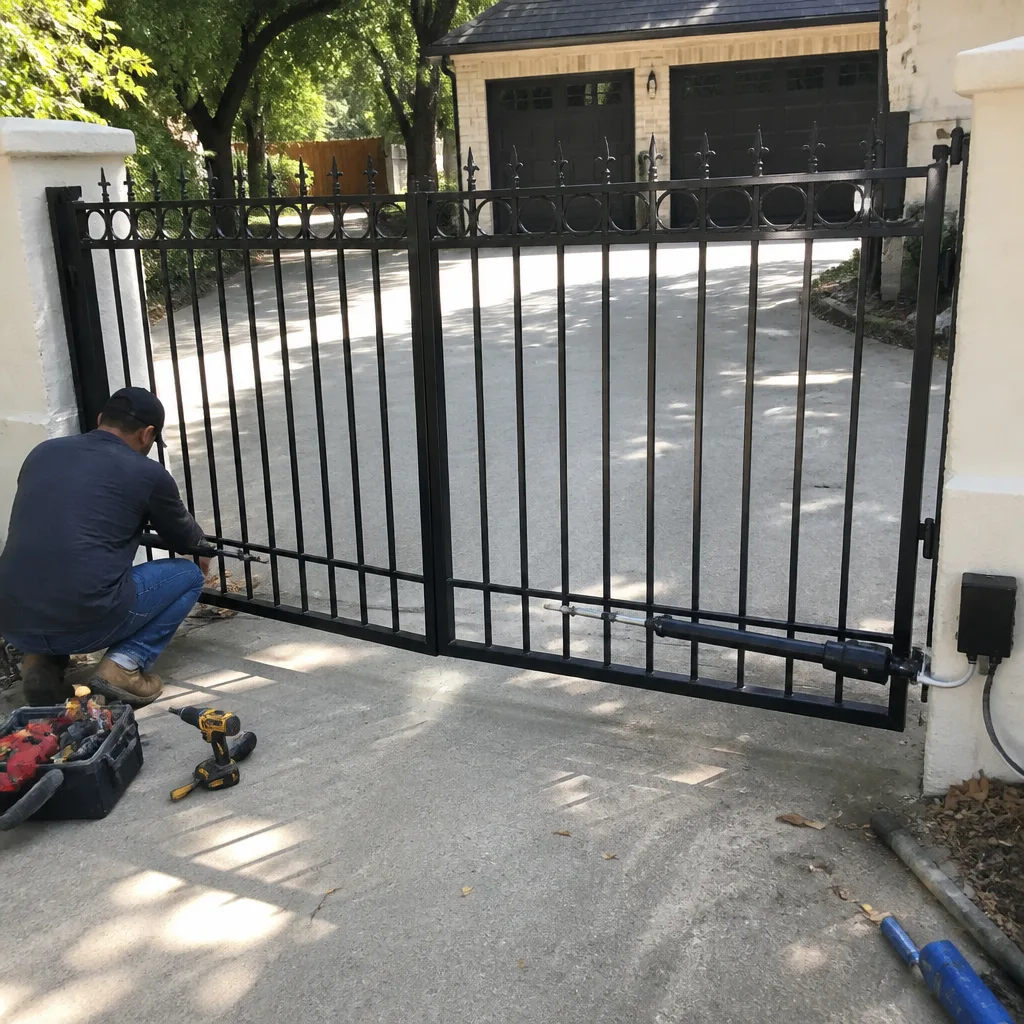 After
After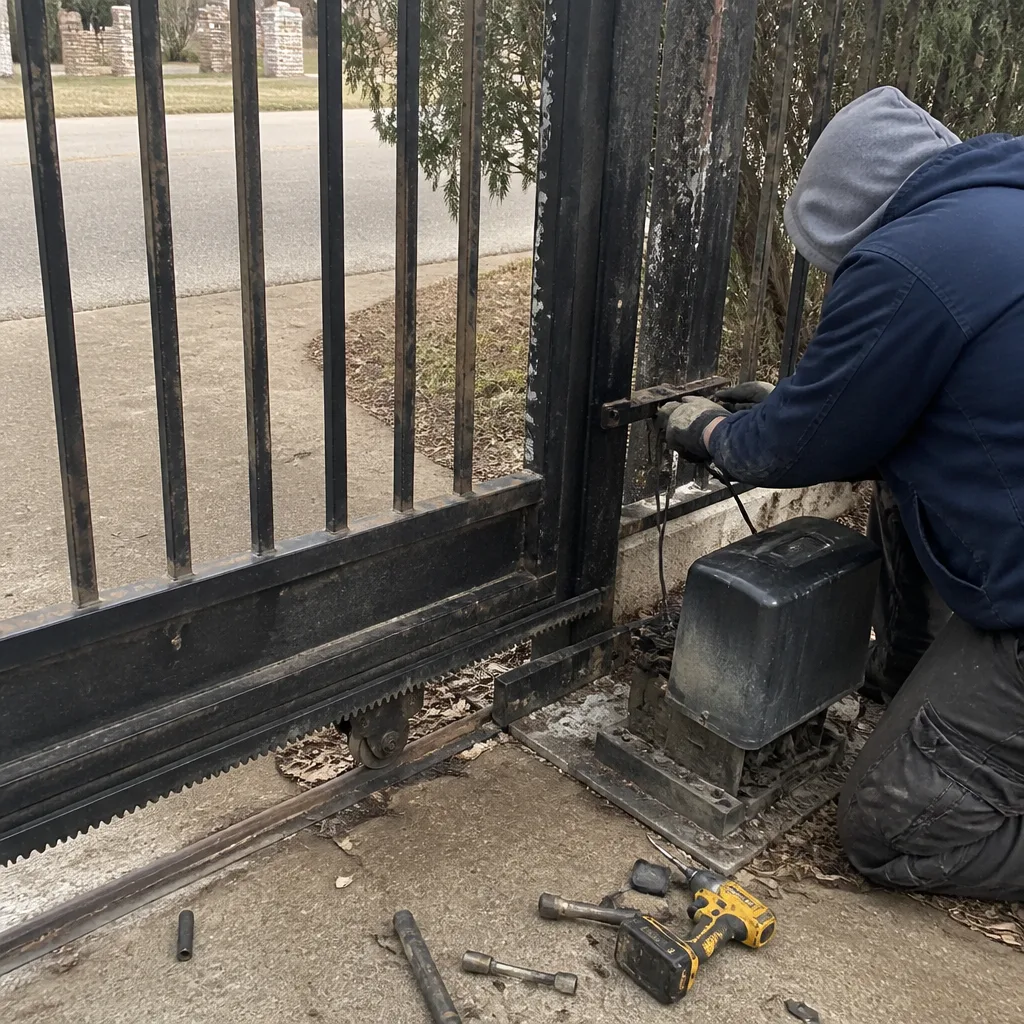 Before
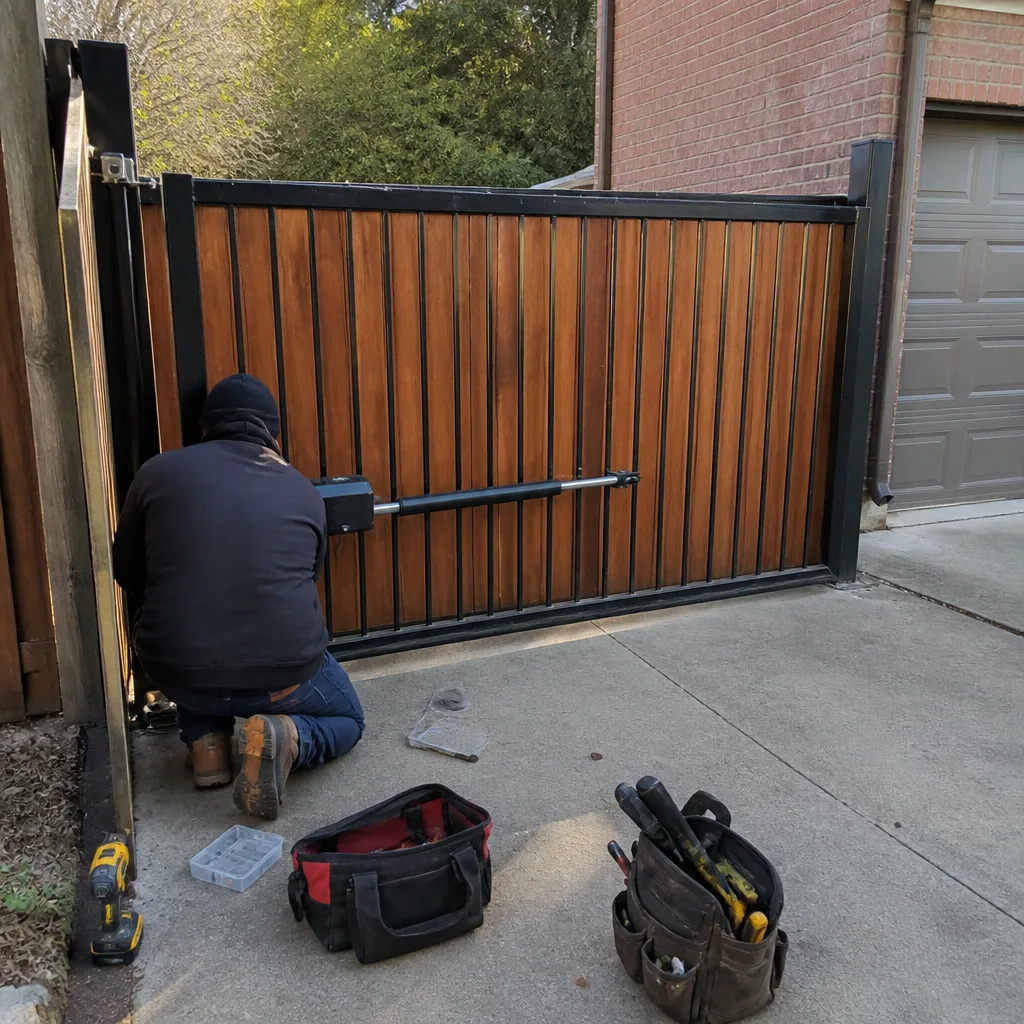 After
AfterGate Repair Maintenance Checklist for Burleson Homeowners
Most gate failures in Burleson don’t start with a dramatic crash. They start with a hinge that’s been dry for two summers, a chain that’s been skipping for three months, and a sensor that’s been misaligned since the last big windstorm in March. By the time a gate stops opening, the expensive damage has usually already happened. This guide walks through the maintenance steps that prevent those failures, the signs that tell you a repair is coming before it strands you in the driveway, and what you can handle yourself versus what needs a trained hand. We’ve maintained and repaired gates in Burleson long enough to know exactly where they fail, and when.
Quick Answer
A driveway gate in Burleson needs attention roughly every three to four months: lubricate the hinges and chain, check the opener’s force settings, test the safety sensors, and clear debris from the track. Most homeowners can handle basic lubrication and visual checks, but spring tension, motor repairs, and electrical work should always go to a licensed professional. A consistent two-hour seasonal check prevents the vast majority of the repair calls we see in this area.
Table of Contents
- Seasonal Maintenance Checklist for Burleson Gates
- Signs Your Gate Needs Repair Before It Fails
- Gate Opener and Motor Maintenance
- Hinges, Welds, and the Burleson Climate
- Safety Sensors, Reversing Edges, and the Law
- Common Mistakes to Avoid
- When to Call a Professional
- Frequently Asked Questions
Seasonal Maintenance Checklist for Burleson Gates
The most useful thing we can tell a Burleson homeowner is this: schedule gate maintenance the same way you schedule changing your HVAC filter. Four times a year, same weekend, same ten minutes of your time. The gate doesn’t care what month it is, but the predictable rhythm keeps small problems from becoming repair bills. Here is the checklist we use on our own seasonal tune-ups, adapted for a homeowner who wants to stay ahead of trouble.
Key Takeaways
- Run through the full visual and mechanical check every three to four months
- Lubricate hinges and chains with a dry silicone or PTFE spray, never grease
- Test the safety reversal system every single time you do maintenance
- Clear leaf litter and dirt from the track and around the opener arm
- Listen for new sounds: a gate should not grind, squeal, or knock
The full seasonal pass takes about twenty minutes once you know what you’re looking at. Start at the gate itself and work back toward the opener.
- Inspect every hinge and bolt. Look for rust streaks, cracked welds, or bolts that have backed out. A sagging gate puts three times the load on the opener motor. In Burleson’s freeze-thaw cycles, concrete anchor bolts can work loose over a single winter.
- Lubricate moving parts. Hinge pins and the opener chain get a light coat of dry lubricant. Do not use WD-40 or axle grease. Grease attracts dust, and Burleson has plenty of dust. The grit turns grease into grinding paste and wears the pins down faster.
- Check the chain or belt tension. A chain that sags more than an inch needs adjustment. A belt that’s loose will slip. Both are straightforward tension fixes, but overtightening destroys bearings. If you can press the chain down more than an inch at the midpoint, call a tech rather than risk it.
- Clear the track and wheels. Slide gates in Burleson collect leaves from the oaks and pecan trees that line so many of the older neighborhoods. Debris in the track causes the motor to work harder, which shortens its life. Clear it every season.
- Test the safety reversal. Place a cardboard box or traffic cone in the gate’s path and activate the close cycle. The gate should stop and reverse before making firm contact. If it doesn’t, that’s not a maintenance issue. That’s a repair, and a safety-critical one.
- Inspect the electrical components. Look at the control board for signs of insect nests, corrosion, or charred connections. Burleson’s summers drive ants and wasps into control boxes. A $90 seasonal tune-up catches this before a $400 board replacement.
One more Burleson-specific note: after a hailstorm or heavy wind event, run through the checklist even if you’re not due. Hail can knock sensors out of alignment, and high winds shift swing gates on their hinges enough to change the opener’s force requirements. The cost of ignoring it is usually a stripped gear inside the motor.
Signs Your Gate Needs Repair Before It Fails
Gates don’t usually break without warning. They telegraph their problems for weeks or months first, and the homeowner who knows what to listen for avoids the 6:30 a.m. Monday scramble when the gate won’t open and the car is trapped behind it. Here are the warning signs we hear about most often from Burleson homeowners who call us.
A gate that’s slower than it used to be
If your gate takes noticeably longer to open or close than it did six months ago, something is loading the motor down. It could be a hinge that’s binding, a wheel that’s dragging in a dirty track, or a capacitor in the opener that’s losing its ability to give the motor its starting jolt. None of these fix themselves. All of them get worse. The motor is the most expensive single component on your gate, and slow operation is the early warning sign that it’s being overworked.
A gate that stops mid-cycle and reverses, or doesn’t move at all
Intermittent operation is the classic symptom of a failing control board or a misaligned safety sensor. In Burleson’s summer heat, control boards inside metal housing boxes can reach 140 degrees or more. Components expand, solder joints crack, and the gate starts behaving unpredictably. If you’re resetting a breaker to get the gate moving, that’s not a nuisance. It’s a component failing under load.
New sounds: grinding, squealing, knocking
A healthy gate hums. A gate with dry hinge pins squeals. A gate with a failing gear inside the opener grinds. A gate with a loose chain slaps or knocks. Each sound points to a specific repair. The longer you wait, the more the repair costs. We’ve replaced $85 hinge pins that would have been caught in a seasonal check, and we’ve replaced $600 opener gears because a squeal was ignored for a year.
Sagging or uneven gate panels
Stand at the end of the driveway and sight down the top edge of the gate. If it’s not level, the hinges are wearing, the post is shifting, or a weld has failed. A sagging gate puts a side-load on the opener arm and the hinge brackets that neither was designed to take. Burleson’s clay soil shifts with moisture, which is why we see more post-leaning issues here than in rocky-soil areas. A sagging gate is always repairable, but it’s cheaper the earlier it’s caught.
Gate Opener and Motor Maintenance
The opener is the heart of the system, and it’s also the part we replace most often in Burleson. Not because the motors are bad. Because they’re ignored until they fail. A gate opener that gets even a little attention every season will typically last seven to twelve years. One that gets none might last four. Here’s what actually matters for opener care.
Force settings and limit switches
Every opener has an adjustable force setting: how hard the motor pushes before the safety system tells it to back off. When a gate gets harder to move because of a dry hinge or a dirty wheel, the motor draws more current to compensate. Some openers automatically adjust. Others hold their setting and strain against the extra load. A homeowner can check the simplest thing: the gate should open and close smoothly without slowing or straining at any single point. If it bogs down mid-travel, something is resisting.
Limit switches control where the gate stops in the open and closed positions. If your gate now stops an inch short of fully closed, or bounces back after reaching the stop, the limit switch or the motor’s encoder needs attention. This is a ten-minute adjustment for a trained tech with the right tools for the brand on your property. We carry programming hardware for Ghost Controls, DoorKing, and Elite systems on every truck, which means most opener adjustments in Burleson are completed in one visit.
Backup batteries
If your opener has a backup battery, it needs a load test every year. Batteries age out even when they’re never used, and Burleson’s summer heat shortens their life. The worst-case scenario is a power outage and a gate with a dead battery, which defeats the entire purpose of having one. A load test takes ten minutes. A replacement battery costs $120 to $250 depending on the model. We recommend swapping backup batteries every three years regardless of test results. It’s cheap insurance against a gate that won’t move during a storm.
Control board and electrical connections
Use your eyes here. Open the control box (kill the power first if you’re comfortable doing so safely) and look for any of these: charred or discolored wire terminals, a burnt smell, insect activity, or visible corrosion on the board. Burleson’s mud daubers and ants love control boxes. They build nests on the warm electronics and short traces when the nest absorbs moisture in the spring. If you see anything that doesn’t look clean, call a professional before you power the system back up. A control board replacement runs $250 to $600 depending on the brand, and most of that is avoidable with a seasonal visual check.
Hinges, Welds, and the Burleson Climate
Burleson sits in a climate band that’s genuinely hard on gate hardware. We get summer days over 100 degrees, winter nights below freezing, spring storms with wind gusts that can hit 60 mph, and enough humidity to keep bare steel rusting year-round. That combination means the mechanical parts of a gate, the hinges and welds and posts, need more attention here than they would in a drier climate.
What rust actually means
Surface rust on a gate is cosmetic. Structural rust is not. The difference shows up at the hinge points and the post bases. If you see flaking, pitting, or rust that has started to layer over itself, the metal is losing cross-section. A hinge pin that loses 30 percent of its diameter to rust becomes the weakest point in the entire system. When that pin shears, the gate drops, and the repair stops being a $40 pin replacement and becomes a full gate reset with possible post repair.
The fix for surface rust is straightforward: wire-brush the affected area, hit it with a rust-converting primer, and spot-paint. The fix for structural rust is a weld repair or a part replacement, and that’s not a homeowner job. We’ve fabricated replacement hinge assemblies for gates in older Burleson neighborhoods where the original parts haven’t been made in twenty years. The welding skill matters, which is why we keep a full fabrication setup in our shop.
Post movement and the soil under Burleson
The clay soil in this part of Johnson County expands when it’s wet and contracts when it’s dry. That movement works on gate posts every single season. A gate post that’s even two degrees out of plumb changes the geometry of the entire gate. The latch stops aligning. The opener arm starts binding. The hinges take a bending load they were never designed for. If your gate used to close easily and now needs a shove, or the latch no longer lines up, measure the post before you adjust anything else. A leaning post is a foundation problem, not a hinge problem, and it needs a professional fix. This is one of the repair patterns we see most often in Burleson’s established subdivisions where gate posts went in thirty years ago without the deeper concrete footings we use today.
Safety Sensors, Reversing Edges, and the Law
This section is not optional reading, and it’s not a DIY section either. Automatic gates are classified as mechanical equipment, and the safety systems on them exist because gates can cause serious injury when those systems are bypassed or neglected. The two primary safety components on a modern gate are the photoelectric sensors (the “eyes” that detect something in the gate’s path) and the reversing edge (the pressure-sensitive strip on the leading edge that tells the opener to stop and reverse on contact).
Here’s the direct answer: if either of these systems is not functioning, the gate is unsafe to operate, full stop. Not inconvenient. Unsafe. This is not a place to save money or defer a repair.
How to test your safety systems
- Place a solid object, like a cardboard box at least two feet tall, in the center of the gate’s closing path.
- Activate the close cycle from the keypad or remote.
- The gate should stop and reverse before it applies any serious pressure to the box.
- If the gate crushes the box, makes contact and keeps pushing, or only reverses after significant resistance, the safety system is not working correctly.
- Repeat the test with the object closer to the hinge post and closer to the latch post. Sensors have blind spots, and a gate can pass a center-path test and still be unsafe near the ends.
In our experience on Burleson properties, the most common sensor failures come from misalignment after windstorms, sun bleaching on the receiver lens, and spider webs inside the sensor housing. The most common reversing-edge failure is a dead pressure strip that has been dead long enough that the homeowner forgot it was supposed to do something. Both failures make the gate a hazard to children, pets, and delivery drivers. The repair is not usually expensive, but it is urgent. A photo-eye replacement runs roughly $90 to $180 installed. A reversing edge replacement runs $150 to $300 depending on gate width. Both are dramatically cheaper than what a failed safety system can cost in injury.
Common Mistakes to Avoid
We’ve walked enough driveways in Burleson to know the mistakes homeowners make, and we’ve watched those mistakes turn $100 repairs into $1,200 replacements. Here are the ones that cost you the most.
- Using the wrong lubricant. Grease clings to the pins and chain, and Burleson’s dust and wind blow grit into it within a week. That grit acts like sandpaper inside the hinge barrels. Dry PTFE or silicone spray at every seasonal check is the right approach. If a part needs grease, it also needs replacement.
- Ignoring a slow gate. “It still works, it’s just slow” is the sentence that precedes more opener motor replacements than any other. A slow gate is a gate loading down. The motor doesn’t recover from sustained overload. It dies.
- Power-washing the gate and opener. A pressure washer forces water into hinge bearings, control boxes, and sensor housings. Burleson’s hard water leaves mineral deposits that corrode connections. Wash the gate with a hose and a soft brush, and stay away from the electronics entirely.
- Disconnecting the safety sensors to “just get it working.” Bypassing a photo-eye or reversing edge takes a gate that is annoying and makes it dangerous. Every operator manual on every brand we service, from Ghost Controls to Mighty Mule, states plainly that the gate must not be operated with the safety system defeated. This is the line we won’t cross on a service call.
- Adjusting the force setting to “fix” a binding gate. Crank enough force into the opener, and a binding gate will move again. For a while. The opener’s gear train takes the abuse, and gears strip. The fix is to eliminate the binding, not to make the motor fight harder. We’ve replaced $500 gear assemblies that started as a $20 dry hinge.
- Planting shrubs too close to the gate track or swing path. Junipers and boxwoods look great framing a driveway, but their roots push against slide gate tracks and their branches trip photo-eye sensors. In Burleson’s clay soil, root movement is a real force. Give the track a clear three-foot zone on either side.
When to Call a Professional
Some gate work is genuinely homeowner-level. Spraying dry lubricant on hinge pins, clearing leaves from a slide track, testing the safety reversal, wiping down the control board, tightening visible bolts. All fair game. But the line between maintenance and repair is where the risk starts, and it’s worth drawing that line clearly.
Call a professional for any repair that involves the opener’s electrical system, the safety sensors, the spring or counterweight tension, a cracked weld, or a post that has moved. These are not jobs where a video tutorial replaces the years it takes to learn how a gate system behaves under load. A gate weighs hundreds of pounds, and the stored energy in a torsion spring or an out-of-balance panel is genuinely dangerous. The gate trade has the same reality as the garage door trade: the high-tension components are the ones that hurt people who treat them casually.
Ironworks Gate Co. offers free estimates in Burleson and the surrounding area. Call (469) 564-8046, and we’ll walk the gate, tell you exactly what it needs, and quote the work in writing before anything starts. No pressure, no surprise line items. If you’re not sure whether something on your gate is a maintenance item or a repair, describe it over the phone. A live person answers, 24 hours a day, and we’ll tell you straight.
Frequently Asked Questions
Four times a year, at the change of seasons. Burleson’s climate, with its hot summers, spring storm season, and freeze-thaw winter cycles, puts enough stress on the hardware that a quarterly check catches problems before they become repairs. The monthly checks we recommend are just visual: is the gate level, are the sensors aligned, is the track clear. Call (469) 564-8046 if anything looks off, and we’ll give you a straight answer over the phone.
Most gate repairs in Burleson run between $150 and $450 for the common problems: sensor realignment, hinge pin replacement, chain tension adjustment, and limit switch resetting. Opener motor replacements run $600 to $1,400 installed depending on brand and horsepower. Control board replacements run $250 to $600. A full gate replacement, when the gate itself has rusted through or the post has failed, runs $1,800 to $6,000 depending on size and material. Every job gets a written quote before work begins, and the $89 Seasonal Tune-Up catches most small problems before they become big ones.
Yes. We keep repair appointments available same-day in Burleson, and a live person answers the phone 24 hours a day, 7 days a week. If your gate is stuck open, stuck closed, or behaving erratically, call (469) 564-8046. We’ll talk through what’s happening, tell you whether it’s safe to leave the gate as-is, and schedule a technician for the first available slot. Most repair jobs in Burleson are completed in a single visit.
We service nine gate automation brands: LiftMaster, FAAC, BFT, Linear, Viking, Ghost Controls, DoorKing, Elite, and Mighty Mule. If your opener is one of those, we carry the programming tools and common parts on the truck. Ghost Controls, DoorKing, and Elite are especially common on Burleson properties, so we keep a deep parts inventory for those three. If your opener is a brand not on that list, call anyway. We’ll tell you honestly whether we can help or whether you’d be better served by the brand’s dealer network.
The $89 Seasonal Tune-Up includes a full lubrication of all hinge points and the drive chain, a check of the opener’s force and limit settings, a safety sensor alignment and test, a control board inspection, and a written report of anything that’s wearing toward failure. If we find something that needs a repair, we’ll quote it separately and show you the worn part. No pressure to approve anything on the spot. The tune-up is available to any Burleson homeowner, and the 5% Senior and Veteran discount applies on top.
It’s a written guarantee on every repair and installation we complete. If the work isn’t right, within 90 days, we come back and make it right. No paperwork, no arguing, no re-negotiating the scope. We call it the Keystone Standard internally, and it’s the same guarantee on the 400th job as it was on the first. It’s how we’ve done business in Burleson for a long time, and it’s why most of our new work comes from neighbors telling neighbors.
The Bottom Line
A driveway gate is a mechanical system, and like any mechanical system, it rewards consistent attention and punishes neglect. The Burleson homeowner who spends twenty minutes four times a year on lubrication, inspection, and safety testing will typically get a decade or more from a gate opener, and longer from the gate itself. The homeowner who waits for the gate to stop working usually pays for a motor replacement, a hinge rebuild, or both. If you’d rather hand the checklist to someone who does this work every day, that’s what we’re here for. Ironworks Gate Co. home is a good place to see the full scope of what we do, from repair and installation to opener service and welding. The seasonal tune-up is $89, the estimate is free, and the work is guaranteed in writing.
Written by Victor Salinas, Owner at Ironworks Gate Co., serving Burleson since 2013.